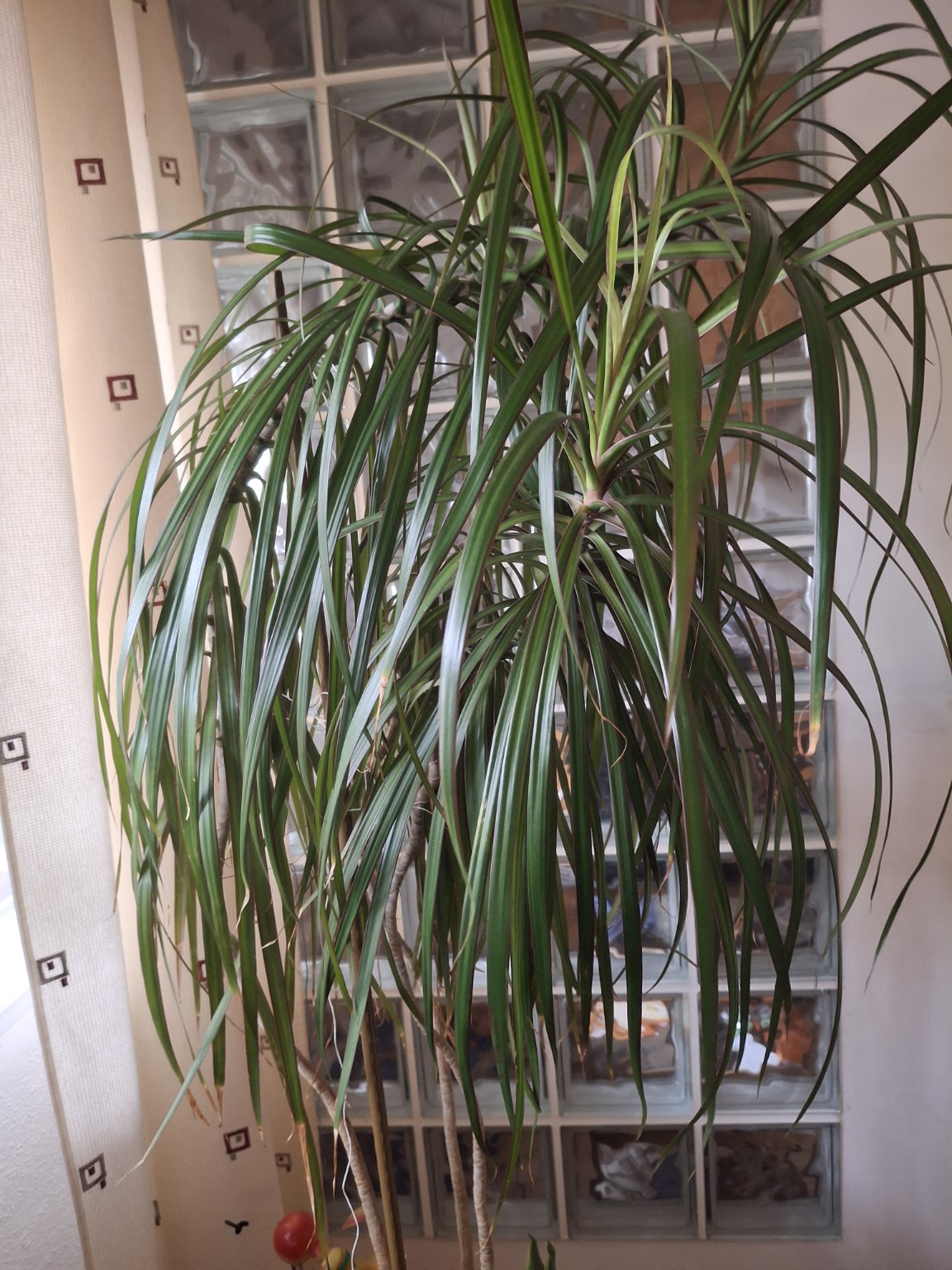
Give the crown useful light
Dracaena marginata, the Madagascar dragon tree, has narrow leaves gathered at the ends of woody stems. Bare lower stems are part of its mature shape. A leafy crown above a long trunk does not, by itself, mean that something has gone wrong.
Choose bright, indirect light. It can tolerate a dimmer position, but growth becomes slower; surviving in a corner is not the same as growing well there. Protect a plant raised in shade from sudden exposure to strong direct sun. Check the light at leaf height, especially when the crown has grown above the window.
Keep it away from cold drafts and hot radiators. A consistently warm room suits it better than a windowsill that becomes cold overnight. If you move it, note the date so that later leaf changes have some context.
Water the root ball, then let it dry partly
Feel the upper 5 cm (about 2 in) of mix before watering. When that layer has dried, check the pot's weight and the moisture below it, particularly in a deep container. A dry surface over a heavy, wet root ball is a reason to wait.
When watering is needed, wet the mix thoroughly and allow excess water to escape. Empty the saucer or outer pot. Small, frequent splashes make it harder to know whether the roots have been watered evenly.
Check again according to conditions, rather than choosing a weekly watering day. A plant in a dim, cool room usually uses water more slowly than one growing actively in better light. Do not keep adding water to drooping leaves when the mix is already damp.
Choose a pot that fits the roots
Use a container with drainage holes and an airy houseplant potting mix. It should hold some moisture while allowing excess water to drain. Avoid dense garden soil and a much larger pot chosen simply to balance the height of the trunk.
Consider repotting when roots form a crowded mass and watering becomes difficult. Water that immediately runs down the sides can leave the middle dry. Check the root ball before deciding whether the plant needs a slightly larger pot. A tall plant with room around its roots may need a heavier outer container for stability, not more wet compost.
Feed modestly during active growth, following the houseplant fertilizer label. Account for nutrients already included in fresh potting mix. Extra fertilizer will not correct poor light or damaged roots and can add to leaf-tip problems.
Brown tips: investigate before treating
Start with the pattern. A few old dry tips call for a different response from damage advancing across several new leaves. Take a photograph and check these possibilities:
- Uneven moisture. Repeated drought, prolonged wetness and a tightly crowded root ball can all interfere with water supply.
- Fertilizer and water quality. Dracaenas are sensitive to fluoride, and accumulated fertilizer salts can also damage tips. If the history fits, reduce unnecessary feeding and consider distilled water or clean rainwater.
- Location. Direct heat, very dry air and strong sun can contribute. Check what reaches the leaves during the day.
Misting is not a lasting way to raise room humidity. If the air is persistently very dry, move the plant away from the heat source and assess the room before buying treatments. Brown tips alone do not prove a humidity problem.
Dry, dead tissue will not become green again. Trim it with clean scissors if it bothers you, keeping the cut within the dry area. Judge improvement by later growth and whether existing damage stops spreading.
Yellow leaves, leaf drop and soft stems
An occasional oldest leaf can be shed as the plant grows. Widespread yellowing or rapid leaf loss deserves a closer look at recent watering, temperature changes and the roots. Record which leaves are affected; color alone will not tell you whether to water.
A softening stem base or collapsing crown is more concerning than a firm, bare trunk. If decline continues while the mix stays wet, inspect the roots. Soft, decaying tissue is a warning sign; do not diagnose rot from root color alone. Remove clearly rotten roots with clean tools and repot any viable remainder in fresh, well-drained mix. Extensive stem decay may leave little that can recover.
For mottled leaves, inspect the undersides and leaf bases for mites, scale or mealybugs. Isolate a plant with visible pests while you identify them. A brown tip without pest evidence is not a reason to apply insecticide.
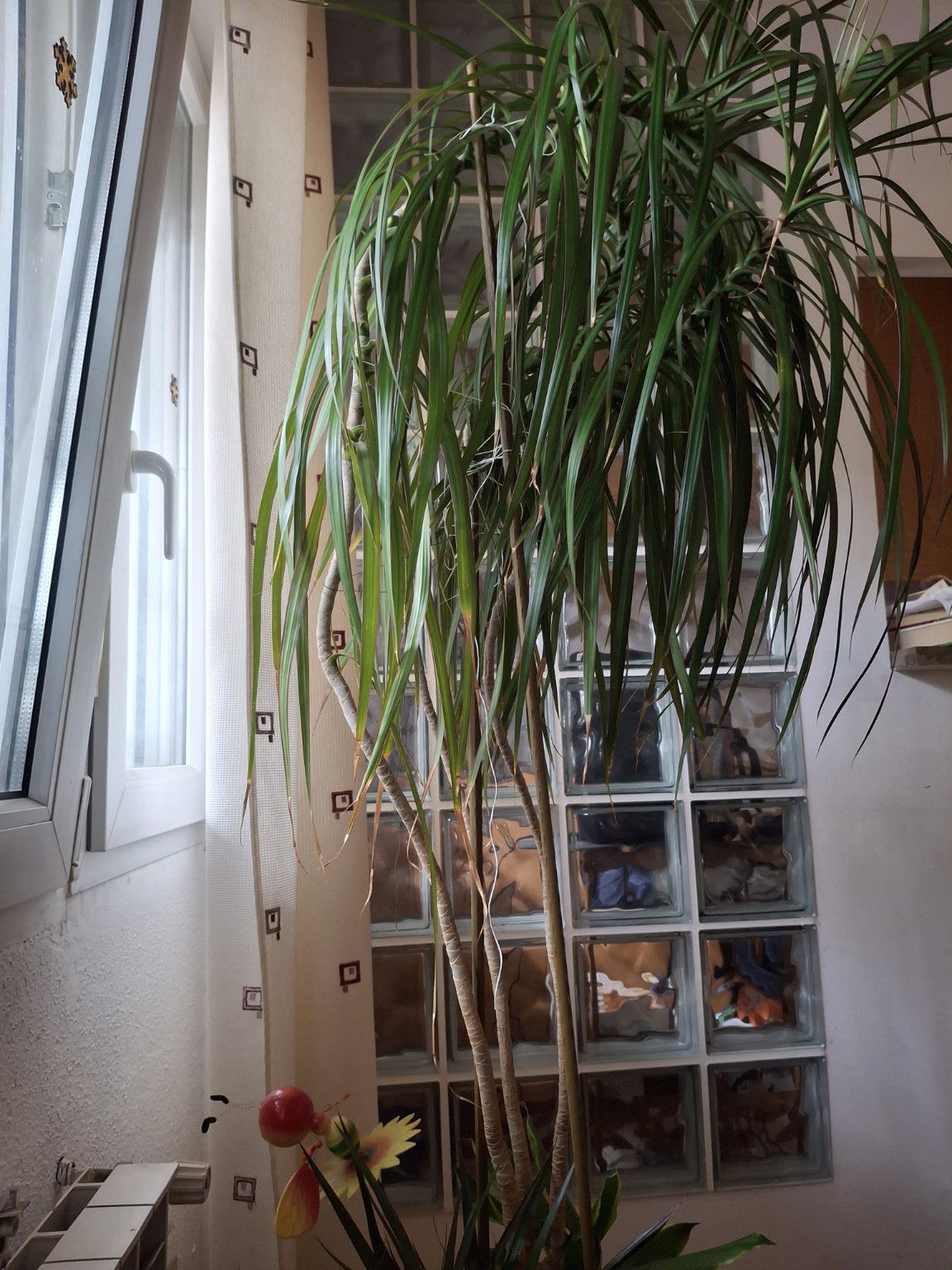
Can a tall dragon tree be shortened?
A healthy woody dracaena can produce shoots below a pruning cut. Decide where you want branching before shortening a stem, and use a clean, sharp tool. Work while the plant is growing well; pruning is not a substitute for investigating a soft trunk or failing roots.
New growth varies with the plant and its conditions. There is no guaranteed number of branches or date for a full crown. If you like the existing tree-like shape, a bare lower stem does not need correcting.
Start with a stem, not a loose leaf
Healthy tips and cane sections can become new plants. For a first attempt, a leafy tip is easy to keep oriented correctly.
- Take a healthy stem tip with several nodes, the points where leaves attach or have left scars. Use clean tools.
- Remove lower leaves that would sit in the rooting mix. Keep foliage above the surface.
- Set the lower end into a small pot of pre-moistened, free-draining propagation mix. Firm it gently enough to support the cutting.
- Keep it warm in bright, indirect light. Maintain light moisture without leaving the pot standing in water.
Leafless cane sections are another option: each needs viable nodes. Mark the upper end before cutting several pieces. Illinois Extension describes sections with at least two nodes, rooted upright or partly buried horizontally. Do not expect a detached leaf to replace a stem cutting, and allow time for roots rather than repeatedly pulling it out to check.
Compare this with other stem-cutting methods; different plants need different starting material.
Keep it away from cats and dogs
The ASPCA lists Dracaena marginata as toxic to cats and dogs. Keep the plant, fallen leaves and pruning waste out of reach. Contact a veterinarian promptly if you suspect ingestion. For a different choice, the spider plant guide explains its non-toxic classification and the limits of that description.
Reference material
Reference material consulted for this independently written guide. The publishers listed have not reviewed or endorsed it.
Photographs on this page were taken by the site owner. They document individual plants, not confirmed diagnoses.
- RHS — How to grow dracaena.
- Clemson Cooperative Extension — Dracaena, HGIC 1504.
- University of Illinois Extension — Dragon Tree; Cuttings.
- University of Maryland Extension — Watering Indoor Plants; Pot-Bound Indoor Plants; Root Rots of Indoor Plants; Diagnose Indoor Plant Problems.
- Iowa State University Extension and Outreach — humidity and the limits of misting houseplants.
- ASPCA — Red-Marginated Dracaena: toxicity to cats and dogs.